

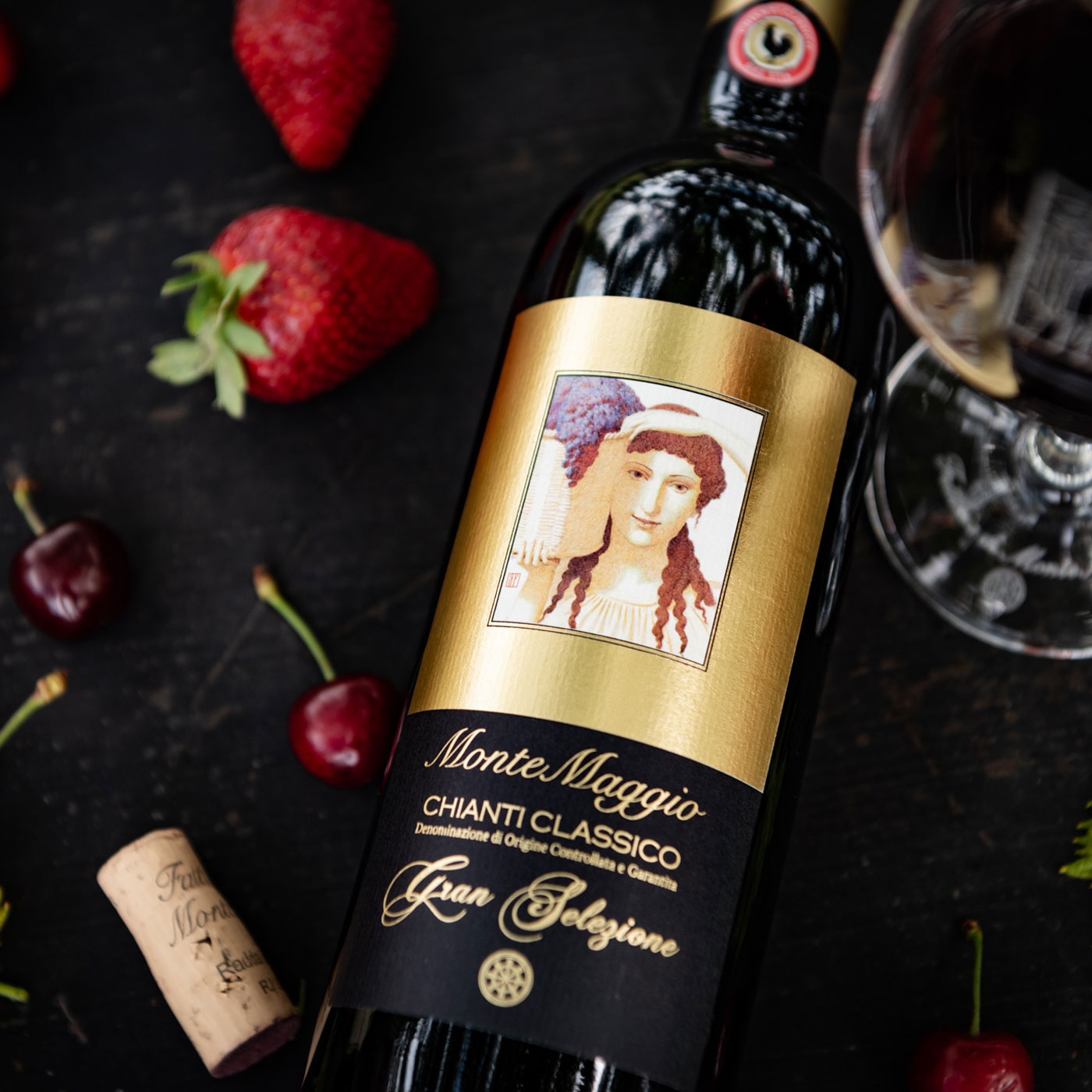
DOCG, the Black Rooster, vintage, Riserva, Gran Selezione and geographical indications: discover what a Chianti Classico wine label tells you and how to choose the right bottle.
Have you ever picked up a bottle of Chianti Classico and wondered what all the information on the label actually means?
A producer’s name, a vintage, the letters DOCG, the famous Black Rooster symbol and sometimes terms such as Riserva or Gran Selezione.
At first glance, these may seem like minor details. In reality, each one tells you something about the wine you are about to purchase.
Learning how to read a Chianti Classico wine label helps you understand its origin, production requirements and the characteristics that make it distinctive.
You do not need to be a sommelier or a wine expert.
A few basic principles can turn a wine label into a valuable source of information, whether you are choosing a bottle in a wine shop or enjoying a guided tasting in Tuscany.
In this guide, we explain the most important information found on a Chianti Classico DOCG label and what to look for before buying a bottle.
1. Chianti Classico DOCG: What Does This Designation Mean?
One of the first things you may notice on a label is Chianti Classico DOCG.
DOCG stands for Denominazione di Origine Controllata e Garantita, which translates as Controlled and Guaranteed Designation of Origin.
It is an Italian wine designation identifying wines produced according to specific regulations within a defined geographical area.
In the case of Chianti Classico, the production area lies between Florence and Siena, in a territory with a long history of winemaking.
The production regulations establish requirements concerning several aspects of winemaking, including:
- The geographical origin of the grapes.
- The permitted grape varieties.
- Maximum production yields.
- The characteristics of the finished wines.
- Winemaking and ageing requirements.
- The controls required to obtain the designation.
The words Chianti Classico DOCG therefore indicate that the wine belongs to a designation with a clearly defined geographical and production identity.
However, this does not mean that every bottle tastes the same.
Within Chianti Classico, significant differences exist depending on the producer, vineyards, vintage and winemaking decisions.
2. The Black Rooster: Why Does It Appear on Chianti Classico Bottles?
The Black Rooster, or Gallo Nero, is the historic symbol of Chianti Classico.
Its origins are connected to the medieval traditions of the region and the famous legend of the rivalry between Florence and Siena.
According to the story, the two cities decided to establish their borders through a competition between two horsemen, who would set off at the crowing of a rooster.
The Florentine horseman, thanks to the early crowing of a black rooster, was supposedly able to travel a greater distance.
Over time, this legend became part of Chianti Classico’s cultural identity.
Today, the Black Rooster represents the Consorzio Vino Chianti Classico and is a distinctive symbol of the designation.
It is important to understand that Chianti and Chianti Classico are not two different names for the same wine.
They are separate wine designations, with their own production areas and regulations.
The Black Rooster helps consumers recognise Chianti Classico and distinguish it from Chianti DOCG.
3. The Vintage: What Does the Year on the Label Tell You?
The vintage indicates the year in which the grapes used to produce the wine were harvested, in accordance with the applicable vintage-labelling rules.
For example, a bottle labelled 2022 refers to grapes harvested in that year.
But why does this matter?
Because every growing season brings different weather conditions.
Temperatures, rainfall, spring and summer weather patterns, and conditions during harvest can all influence grape ripening.
As a result, the same wine produced by the same winery may display different characteristics from one vintage to another.
Is an older vintage always better?
No.
This is one of the most common misconceptions about wine.
An older wine is not necessarily better than a younger one.
Some wines are particularly enjoyable when they express freshness and vibrant fruit.
Others may develop greater complexity through bottle ageing.
A wine’s ageing potential depends on its structure, vintage, production methods and storage conditions.
Understanding the vintage is useful, but the year alone cannot determine the quality of a bottle.
4. Chianti Classico Annata, Riserva and Gran Selezione: What’s the Difference on the Label?
Chianti Classico bottles may carry different classifications.
The three main categories are:
- Chianti Classico.
- Chianti Classico Riserva.
- Chianti Classico Gran Selezione.
These indicate wines subject to different production requirements.
Chianti Classico Annata
The term Annata is commonly used to distinguish the standard Chianti Classico category from Riserva and Gran Selezione.
These wines can express freshness, fruit character and a strong connection to Sangiovese.
Depending on the producer, they may be approachable and easy to enjoy or surprisingly structured.
The standard category should therefore not automatically be considered a simple wine.
Chianti Classico Riserva
The term Riserva identifies a wine that must meet a longer minimum ageing requirement than standard Chianti Classico.
Chianti Classico Riserva requires at least 24 months of ageing, including a minimum of three months in bottle.
The result may be a wine with greater complexity and structure, although its style always depends on the producer’s decisions.
Chianti Classico Gran Selezione
Gran Selezione has specific production requirements, including the use of grapes grown in the producer’s own vineyards and a minimum ageing period of 30 months, including at least three months in bottle.
This category is particularly interesting for anyone wishing to explore the different territorial expressions of Chianti Classico.
The three categories should not simply be viewed as three progressively higher levels of quality.
They represent different production requirements and can offer distinct tasting experiences.
The best wine is the one that suits your preferences, not necessarily the one with the most prestigious classification.
5. Sangiovese: What Should You Know About Chianti Classico Grape Varieties?
Sangiovese is the principal grape variety of Chianti Classico.
Under the production regulations, it must account for at least 80% of the grapes used in standard Chianti Classico and Riserva.
The remaining proportion, where used, may include other permitted red grape varieties.
Chianti Classico can also be produced from 100% Sangiovese.
Specific, stricter grape-composition requirements apply to Gran Selezione.
Sangiovese is particularly appreciated for its acidity, tannic structure and ability to express the characteristics of its growing environment.
It can display aromas of cherry, red berries and Mediterranean herbs, developing more complex notes as it evolves.
However, not all Sangiovese wines taste alike.
Altitude, vineyard exposure, soil, seasonal weather and winemaking techniques can all contribute to very different results.
Does the label always state the percentage of Sangiovese?
No.
The exact grape composition is not necessarily printed on the bottle.
To find out the percentages, you can consult the producer’s technical sheet or ask directly at the winery.
6. The Producer’s Name: Why Is It So Important?
The name of the winery is one of the most important details to consider.
The production regulations establish common requirements for the designation, but every producer develops a distinctive identity.
Decisions begin in the vineyard.
Soil management, canopy management, grape selection and harvest timing can all influence the wine’s characteristics.
These are followed by decisions concerning fermentation, winemaking and ageing.
Some producers focus on highlighting the freshness of Sangiovese.
Others aim for more structured wines or distinctive expressions of individual vineyard sites.
For this reason, knowing the producer can be just as useful as understanding the designation.
Visiting a winery allows you to discover the decisions behind the label.
7. Geographical Indications: What Are the Chianti Classico UGAs?
One of the most interesting developments within the designation is the introduction of Unità Geografiche Aggiuntive (UGA), or Additional Geographical Units.
UGAs are designed to highlight specific geographical areas within the Chianti Classico territory.
These include areas such as Radda, Gaiole, Castellina, Greve, Panzano and Lamole, among others.
The system was introduced to make the connection between a wine and its geographical origin more visible.
Can every Chianti Classico wine display a UGA?
No.
The use of UGA names is regulated and currently applies to the Gran Selezione category, subject to the relevant requirements.
It is not simply an indication that any producer can add freely to every Chianti Classico bottle.
Why are UGAs interesting?
Because they help explain that Chianti Classico is not a uniform wine region.
Different areas may have distinctive climates, elevations and geological characteristics.
This does not mean that all wines from the same UGA taste identical.
Rather, geographical origin becomes an additional element in understanding the identity of a wine.
8. What Does Organic Mean on a Wine Label?
Another important detail may concern organic certification.
Certified organic wine is produced according to specific European regulations governing both grape growing and winemaking.
The European organic logo, where applicable, helps consumers identify certified products.
Organic certification should not be confused with general expressions such as natural, sustainable or artisanal, which do not necessarily carry the same regulatory meaning.
Is organic wine automatically better?
Not necessarily.
Organic certification confirms compliance with specific production standards.
The sensory quality of a wine also depends on grape quality, vintage conditions, winemaking expertise and numerous other factors.
However, for consumers interested in the relationship between viticulture and the environment, certification provides valuable information.
At Fattoria di Montemaggio, in the Radda in Chianti area, organic viticulture is a central part of the estate’s philosophy.
9. Alcohol Content: What Does It Tell You About the Wine?
Wine labels display the alcoholic strength by volume, expressed as a percentage.
For example, you might see 13.5% vol. or 14% vol.
Alcohol content can offer some indication of a wine’s body and perceived warmth, but it cannot determine quality on its own.
A wine with a higher alcohol percentage is not necessarily more intense in aroma.
Similarly, a lower alcohol percentage does not automatically mean that the wine will feel lighter overall.
The final impression depends on the balance between alcohol, acidity, tannins, concentration and other components.
10. The Back Label: What Information Should You Check?
In addition to the main label, many bottles have a back label.
This may contain both mandatory and optional information.
Details worth checking include:
- The nominal bottle volume.
- The alcoholic strength.
- Identification of the responsible operator.
- The production lot.
- Allergen information, where applicable.
- Ingredients and nutritional information, in accordance with relevant regulations.
- Optional wine descriptions or serving suggestions.
European wine-labelling regulations have evolved in recent years, introducing additional information requirements for wines within their scope.
Certain information may also be provided electronically, for example through a QR code, in accordance with the applicable rules.
What is the QR code on a wine label for?
It may provide access to additional information, including details required by wine-labelling regulations.
However, not every QR code serves the same purpose.
Some lead to regulatory information, while others link to content provided by the winery.
It is therefore useful to check what information the code actually provides.
11. How to Choose a Chianti Classico by Reading the Label
Now that you understand the main indications, you can use the label to make a more informed choice.
Before purchasing, consider four key elements.
The designation: Check that the wine is Chianti Classico DOCG if that is what you are looking for.
The category: Decide whether you would prefer standard Chianti Classico, Riserva or Gran Selezione.
The producer: Learn about the winery, its location and its production philosophy.
The vintage: Consider the harvest year and, where possible, the characteristics of that particular wine.
You can also look for organic certification, geographical indications and information available in the producer’s technical sheet.
However, remember that a label cannot tell you everything.
Two bottles with apparently similar information may offer very different sensory experiences.
This is why wine tasting remains one of the best ways to develop your understanding of wine.
12. Why Does Visiting a Winery Help You Understand Wine Labels?
Reading a label is an excellent starting point.
But visiting a winery allows you to connect that information to something tangible.
The name of a wine region becomes a landscape.
The grape variety becomes a vine growing in the vineyard.
The vintage becomes the story of a particular growing season.
The terms Riserva and Gran Selezione become opportunities to understand different production decisions.
During a guided tasting, you can compare different wines and discover how the information printed on their labels translates into sensory characteristics.
It is an accessible and engaging way to turn theory into experience.
Discover Chianti Classico at Fattoria di Montemaggio
In the heart of Chianti Classico, in Radda in Chianti, Fattoria di Montemaggio is an organic winery surrounded by vineyards, olive groves and woodland.
Parts of the estate reach approximately 600 metres above sea level, and its vineyard environment includes soils characterised by galestro and alberese.
Sangiovese plays a fundamental role in the estate’s wine production.
Through its wine tasting experiences, visitors can explore the connection between terroir, organic viticulture and the characteristics of the wines.
Comparing different labels offers an opportunity to understand how vineyard management, winemaking and ageing contribute to the identity of each bottle.
A visit therefore allows you to go beyond the information printed on the label and discover the place where the wine is produced.
To explore the available wine tasting experiences and plan your visit:
Frequently Asked Questions About Chianti Classico Wine Labels
How can you recognise a Chianti Classico bottle?
Look for the Chianti Classico DOCG designation and the Black Rooster symbol, which identifies the designation.
What does DOCG mean on a Chianti Classico bottle?
DOCG stands for Denominazione di Origine Controllata e Garantita, or Controlled and Guaranteed Designation of Origin. It identifies a wine produced according to specific regulations within a defined geographical area.
Are Chianti and Chianti Classico the same wine?
No. They are two separate designations with different production areas and regulations.
What does the Black Rooster represent?
It is the historic symbol of Chianti Classico, connected to the region’s traditions and the famous legend of the rivalry between Florence and Siena.
What does Riserva mean on a wine label?
It identifies a category subject to specific production requirements, including a longer minimum ageing period than standard Chianti Classico.
What does Gran Selezione mean?
It is a Chianti Classico category with specific production requirements, including grapes grown in the producer’s own vineyards and a minimum ageing period of 30 months.
Is an older Chianti Classico always better?
No. Quality and ageing potential depend on several factors, including the producer, vintage, wine structure and storage conditions.
Is Chianti Classico always made from 100% Sangiovese?
No. Standard Chianti Classico and Riserva must contain at least 80% Sangiovese, while Gran Selezione follows stricter grape-composition requirements.
What does UGA mean on a Chianti Classico label?
UGA stands for Unità Geografica Aggiuntiva, or Additional Geographical Unit. It is a regulated indication identifying specific geographical areas, currently used for Gran Selezione.
How can you recognise an organic Chianti Classico?
Look for organic certification information and the European organic logo, where applicable.
Does alcohol content indicate wine quality?
No. Alcohol content is only one element contributing to a wine’s characteristics and is not, by itself, an indicator of quality.
Where can you learn more about Chianti Classico?
A guided wine tasting at a winery in the region is an excellent way to understand differences between wines and connect the information on their labels with their sensory characteristics.
Beyond the Label: The Best Way to Understand Chianti Classico
A wine label can tell you many things.
It can identify the wine’s origin, vintage, designation, category and producer.
It can provide information about production requirements and help you make a more informed purchasing decision.
But it cannot replace the experience of tasting.
To truly understand Chianti Classico, you need to observe, smell, taste and, whenever possible, discover the territory where it is produced.
At Fattoria di Montemaggio, in the heart of Radda in Chianti, Sangiovese reflects the relationship between altitude, soil, organic viticulture and winemaking decisions.
A guided tasting allows visitors to discover these elements directly through the wines.
Because learning to read a wine label is the first step. Understanding what is inside the bottle is the real journey.
Discover Fattoria di Montemaggio and plan your Chianti Classico wine tasting experience:
About the Author
Francesco Garuglieri is a Wine Communicator at Fattoria di Montemaggio, an award-winning organic winery in the heart of Chianti Classico, Tuscany.
Specialising in wine communication and hospitality, his work focuses on making wine accessible by connecting terroir, organic viticulture, biodiversity and the experience of visiting Tuscany. His articles explore Chianti Classico, wine tourism and the culture behind authentic Tuscan wine experiences.
SEO Package
Primary keyword: how to read a Chianti Classico wine label
Secondary keywords: Chianti Classico DOCG label, Black Rooster wine symbol, Chianti Classico Riserva meaning, Gran Selezione wine label, wine vintage meaning, Chianti Classico UGA, organic wine label Italy, Sangiovese Chianti Classico, Chianti vs Chianti Classico
Long-tail keywords:
- how to read a Chianti Classico wine bottle label
- what does DOCG mean on Chianti Classico
- how to identify authentic Chianti Classico wine
- what does the Black Rooster mean on Italian wine
- difference between Chianti Classico Annata Riserva and Gran Selezione
- what does vintage mean on a wine label
- what are the Chianti Classico UGAs
- how to recognise organic Chianti Classico wine
- how to choose a bottle of Chianti Classico
- what to check before buying Chianti Classico
Meta description: Learn how to read a Chianti Classico wine label. Discover what DOCG, the Black Rooster, vintage, Riserva, Gran Selezione and UGA mean.
SEO slug: how-to-read-chianti-classico-wine-label
Tags: Chianti Classico, Wine Labels, DOCG, Black Rooster, Sangiovese, Gran Selezione, Chianti Classico Riserva, Chianti Classico UGA, Organic Wine, Fattoria di Montemaggio
Leave a Reply