


Why a winery visit can become one of the highlights of your trip to Tuscany
If you are planning a trip to Tuscany, you may be wondering:
Is a wine tasting in Chianti Classico really worth it?
The short answer is yes — especially if you choose an experience that goes beyond simply pouring a few glasses of wine.
A proper Chianti Classico wine tasting gives you the opportunity to understand the landscape, meet the people behind the bottles, walk through the vineyards and discover why wines produced only a few kilometres apart can taste remarkably different.
For many travellers, it becomes much more than an activity to add to a Tuscany itinerary.
It becomes one of the experiences they remember most.
What actually happens during a wine tasting in Chianti Classico?
Every winery has its own approach, so experiences can vary considerably.
A complete winery visit will usually take you through several stages.
You may start in the vineyard, where you learn about the vines, soils, climate and growing season.
Then you move into the cellar to understand fermentation, ageing and the decisions that transform grapes into wine.
Finally, you sit down for the tasting.
By that point, however, the wine in your glass means something different.
You have seen where it came from.
Why visiting the vineyard matters
You can learn a lot about wine from books.
But some things become immediately clearer when you are standing among the vines.
You can see the slope of the vineyard.
Feel the temperature.
Look at the soil.
Notice the forests surrounding the estate.
Understand the altitude.
Suddenly, terroir stops being an abstract concept.
The landscape itself becomes part of the explanation.
This is one of the reasons the best wine tastings in Chianti Classico begin long before the first wine is poured.
You don’t need to be a wine expert
One of the biggest concerns first-time visitors have is that they will not know enough about wine.
You don’t need to.
A great wine tasting should be enjoyable whether you know the difference between Chianti and Chianti Classico or have never heard the word Sangiovese before.
The experience should help you understand:
- how to approach a wine
- what acidity and tannins actually feel like
- why aromas develop
- how ageing influences a wine
- why terroir matters
- how different wines can express the same territory
There are no exams.
And there should be no pressure to identify fifteen different aromas in your glass.
Curiosity is enough.
Wine tastes different when you drink it where it was made
There is something surprisingly powerful about tasting wine in the place where it was produced.
You have just walked through the vineyard.
Perhaps you have seen the tanks where fermentation takes place.
You have visited the ageing cellar.
Then someone pours the finished wine into your glass.
Everything connects.
The landscape, the agricultural work, the vintage and the cellar are no longer separate ideas.
They become part of the same story.
And that is something drinking the same bottle at home simply cannot reproduce.
Why Chianti Classico is particularly interesting for wine tasting
Chianti Classico is much more diverse than many first-time visitors expect.
Altitude changes.
Soils change.
Exposure changes.
Microclimates change.
Even vineyards located relatively close to one another can produce very different expressions of Sangiovese.
This means that visiting the region isn’t simply about tasting “Chianti.”
It is about discovering how individual places shape wine.
That is one of the most fascinating parts of a wine tasting in Chianti Classico.
What makes the best wine tasting in Chianti Classico?
There is no universal answer because every traveller wants something different.
Some prefer luxury.
Others are interested primarily in historic estates.
Some want technical tastings.
Others simply want to enjoy Tuscany with a beautiful glass of wine.
But if you are searching for an authentic experience, there are several things worth looking for:
- access to the vineyard
- a real working winery
- knowledgeable guidance
- small groups
- enough time for questions
- a connection with local food
- a clear explanation of the territory
- genuine hospitality
The number of wines poured is not necessarily what determines the quality of the experience.
Understanding what you are drinking matters much more.
Why visit an organic winery?
Visiting an organic winery adds another dimension to the experience.
Wine begins with agriculture, and organic viticulture makes that connection particularly visible.
Walk through an organically farmed vineyard and you may notice life between the rows, wild vegetation, insects, surrounding woodland and a landscape that feels much less separated from nature.
You begin to understand that the vineyard is not an isolated production system.
It is part of an ecosystem.
And once you understand that, you begin to look at the wine differently too.
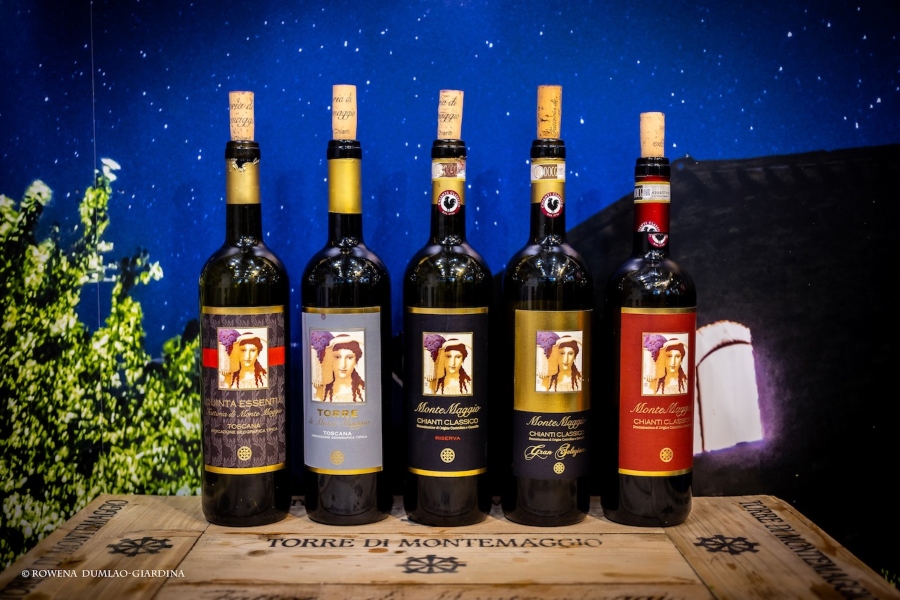
Wine tasting at Fattoria di Montemaggio
At Fattoria di Montemaggio, the tasting experience is designed around precisely this connection between wine and place.
Located near Radda in Chianti, in the heart of Chianti Classico, Montemaggio is an organic estate surrounded by vineyards, olive groves and woodland.
Rather than beginning and ending at the tasting table, the experience introduces visitors to the world behind the bottle.
The vineyard.
The cellar.
Organic farming.
Terroir.
And finally, the wine.
More than wine: olive oil and Tuscan food
Understanding Tuscany through wine also means understanding its food culture.
Wine has never existed here in isolation.
Olive oil, bread, cheese, cured meats and other local products have traditionally shared the same table.
At Montemaggio, different tasting experiences allow visitors to discover the estate’s wines alongside extra virgin olive oil and Tuscan products.
This isn’t simply about adding food to a tasting.
It gives the wines context.
And it helps explain why food and wine have evolved together in this part of Italy.
What makes Fattoria di Montemaggio different?
For travellers looking for one of the best wine tasting experiences in Chianti Classico, Montemaggio combines several elements that are particularly valuable:
- organic viticulture
- vineyards at significant altitude
- a landscape surrounded by woodland
- estate-produced wines
- extra virgin olive oil
- guided wine education
- small-group hospitality
- different tasting experiences for different levels of interest
But perhaps the most important element is the approach.
The objective isn’t to tell visitors what they should taste.
It is to give them enough context to understand what they are tasting for themselves.
How much time should you allow for a winery visit?
Don’t rush it.
If you are travelling through Chianti Classico, it can be tempting to visit as many wineries as possible.
But two meaningful experiences will usually teach you far more than four rushed ones.
Allow enough time to walk.
Ask questions.
Taste slowly.
Enjoy the food.
Look at the landscape.
Wine tourism works best when you stop treating it like a checklist.
Is a Chianti Classico wine tasting worth it for non-wine drinkers?
This depends on how interested you are in food, agriculture, landscape and Tuscan culture.
A winery visit isn’t necessarily only for serious wine lovers.
Even if wine isn’t the central passion of your life, visiting an estate can offer insight into:
- local agriculture
- Tuscan history
- food traditions
- sustainability
- rural life
- the landscape
Wine simply becomes the thread connecting everything together.
So, is a wine tasting in Chianti Classico worth it?
Yes — if you choose the right experience.
If your idea of wine tasting is simply drinking several wines as quickly as possible, you can do that almost anywhere.
But if you want to understand why Chianti Classico is one of Italy’s most celebrated wine regions, visiting a real winery can completely change your perspective.
The best experiences connect what you see in the vineyard with what you eventually taste in the glass.
And that connection is difficult to recreate anywhere else.
Discover Chianti Classico at Fattoria di Montemaggio
If you’re searching for an authentic wine tasting in Chianti Classico, Fattoria di Montemaggio offers the opportunity to experience wine as part of something larger: the landscape, agriculture, food and culture of Tuscany.
Because sometimes the best thing you take home from a wine tasting isn’t a bottle.
It’s understanding why that bottle tastes the way it does.
👉 Discover our wine tasting experiences:
https://www.montemaggio.com/wine-tasting-chianti-classico
👉 Book your visit:
https://www.montemaggio.com/tour-reservation
✍️ ABOUT THE AUTHOR
Francesco Garuglieri is a Wine Communicator at Fattoria di Montemaggio, an award-winning organic winery in the heart of Chianti Classico, Tuscany.
Specialising in wine communication and hospitality, his work focuses on making wine accessible by connecting terroir, organic viticulture, biodiversity and authentic Tuscan hospitality. His articles explore Chianti Classico, wine tourism and the culture behind meaningful wine experiences in Tuscany.
Leave a Reply