


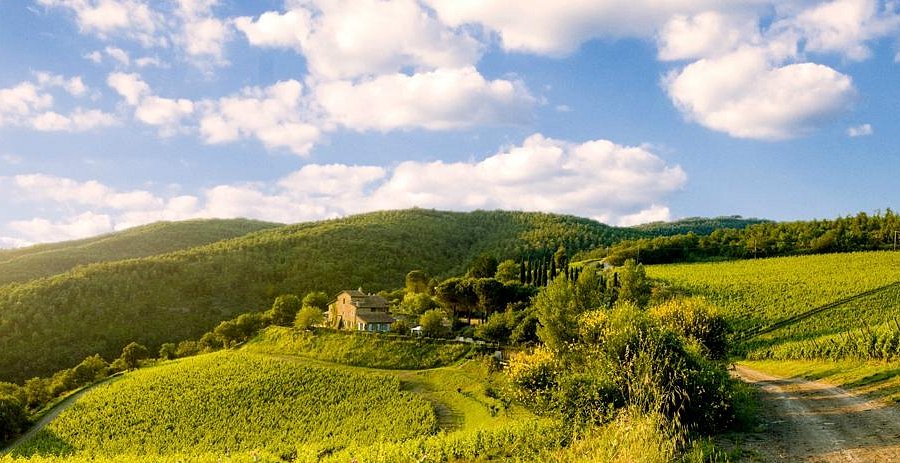
Why a place speaks even when nothing seems to happen
When people talk about Chianti Classico, they often mention wine, rolling hills, and medieval villages.
Less often do they speak about silence.
And yet, silence is one of the most present — and most decisive — elements of this territory.
Not as an absence, but as space. Space to observe, to listen, to slow down.
Those who arrive in Chianti Classico expecting constant stimulation risk missing one of its deepest qualities. Here, much of what matters happens when, apparently, nothing is happening at all.
1. Silence as part of the landscape
In Chianti Classico, silence is not emptiness.
It is an integral part of the landscape, just like vineyards, forests, and unpaved roads.
It is a silence made of:
-
wind moving through leaves
-
footsteps on gravel
-
distant, unobtrusive sounds
This kind of silence does not isolate.
It connects.
It allows the land to be perceived not as a backdrop, but as a living environment.
2. Why silence has become rare
We live in a time saturated with sound, notifications, and constant stimuli.
Travel often reproduces the same pattern: full schedules, continuous explanations, no pauses.
Silence has become rare because it is not productive, not measurable, not easily marketable.
And precisely for this reason, its value has grown.
In Chianti Classico, silence is not constructed.
It is the natural result of an agricultural territory still guided by its own rhythms.
3. Silence as a condition for listening
To truly listen to a place, silence is necessary.
Not only external silence, but internal silence as well.
When noise fades:
-
attention sharpens
-
details emerge
-
the perception of time changes
This applies to landscape, wine, and human relationships alike.
Silence creates the conditions for understanding — not just observing.
4. Landscape and time: an inseparable bond
The Chianti Classico landscape does not reveal itself all at once.
It requires time.
Silence allows time to stretch — not chronologically, but perceptually.
Walking without urgency, stopping without a specific goal, observing without immediately reaching for a camera: these simple gestures profoundly change how a place is experienced.
In places like Fattoria di Montemaggio, the landscape is not designed to entertain, but to be inhabited — even if only for a few hours.
5. Silence as a form of respect
There is a form of respect that comes from not intervening too much.
From not filling every space.
In Chianti Classico, silence is a gesture of respect toward:
-
the land
-
agricultural work
-
the people who live this territory
Not everything needs to be explained.
Not everything needs to be spoken aloud.
Sometimes, allowing a place to speak for itself is the most coherent choice.
6. When silence becomes experience
Silence does not automatically become an experience.
It becomes one when it is welcomed, not avoided.
For many people, the first encounter with silence can feel unsettling.
But once that threshold is crossed, something unexpected often appears: clarity, calm, presence.
In those moments, travel stops being consumption and becomes experience.
7. Silence and memory
The noisiest experiences are not always the most memorable.
Often, memory holds on to quiet, seemingly marginal moments.
A view observed without hurry.
A glass held without speaking.
An afternoon with no plan.
Silence leaves space for memory, because it does not overload it.
Conclusion — Listening to what makes no noise
Chianti Classico does not demand constant attention.
It does not impose itself.
It does not raise its voice.
Instead, it asks for willingness to listen.
Its silence is not absence, but a subtle presence.
And for those willing to slow down, it becomes one of the most precious elements of the journey.
Leave a Reply