


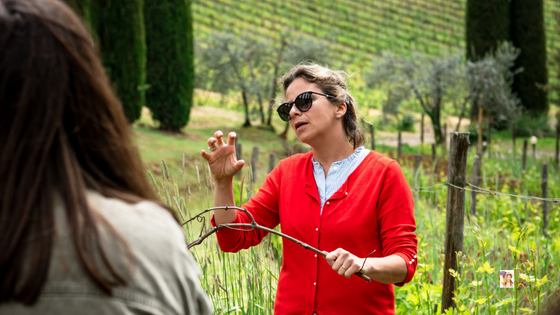
When a winery is, above all, a place that is lived
When people talk about wine, they often talk about bottles, labels, and vintages.
Much less often do they talk about lived places.
And yet, before it becomes a product, wine is the result of a space that is experienced every day.
A place that is walked, observed, and cared for. A place where agricultural work is not occasional, but constant.
At Montemaggio, as in many authentic agricultural estates of Chianti Classico, wine is born from this daily relationship with place. Not from an abstract project, but from a way of living the land.
1. The difference between visiting and living
To visit a place means to pass through it for a limited time.
To live it means to know its details, its silences, its subtle changes.
Those who live among vineyards:
-
recognize small variations
-
accept contradictions
-
respect limits
Wine that comes from a lived place carries this continuity within it.
It is not designed to impress immediately, but to tell a story that unfolds over time.
2. Wine as a consequence, not a goal
In many modern narratives, wine appears as the starting point:
the style is decided first, and everything else is built around it.
In an authentic agricultural approach, the opposite happens.
Wine is a consequence.
A consequence of:
-
a specific landscape
-
soils observed over years
-
choices repeated with coherence
-
mistakes recognized and corrected
This kind of wine does not try to prove anything.
It exists because the place makes it possible.
3. Living the agricultural rhythm
Living a winery also means accepting a rhythm that cannot be negotiated.
Agricultural time does not adapt to commercial deadlines or external expectations.
It is made of:
-
waiting
-
intense periods followed by quieter ones
-
repeated gestures
-
decisions that mature slowly
This rhythm shapes not only the wine, but also the way the place welcomes visitors. The experience is not separate from the work — it is a natural extension of it.
4. The role of space in wine identity
Every wine carries a precise physical space within it.
Not only in terms of terroir, but as a lived environment.
Vineyards, woods, access roads, the layout of agricultural spaces — all contribute to a coherent identity.
In places like Fattoria di Montemaggio, this space is not simplified or neutralized for visitors. It remains authentic, because it is first and foremost functional to agricultural life.
5. Welcoming without separation
When a winery is truly lived, hospitality is not an added feature.
There is no rigid separation between “those who work” and “those who visit.”
This does not mean neglecting care for guests, but offering it coherently:
without theatrics, without forced routes, without scripted narratives.
Those who visit a lived place perceive this difference.
Not as something explicitly stated, but as a sense of continuity.
6. Wine as the trace of a presence
Wine born from a lived place is never neutral.
It carries the trace of a constant human presence — attentive, not invasive.
Not an obvious signature, but an equilibrium.
A way of being on the land that is reflected in the glass.
This kind of wine does not seek immediate consensus.
It asks for attention.
7. Why this approach matters today
In an increasingly accelerated world, the idea of living a place — rather than exploiting or merely passing through it — is becoming central again.
In wine, this translates into:
-
fewer artifices
-
more coherence
-
a deeper bond with the territory
This is not a nostalgic choice.
It is a deeply contemporary one.
Conclusion — Wine as a way of living
Living wine means recognizing that not everything is meant to be optimized.
Some things are meant to be cared for, accompanied, respected.
When a winery is first and foremost a lived place, wine stops being an isolated object and becomes a form of relationship.
And it is often this quiet, consistent relationship
that makes a wine truly recognizable over time.
Leave a Reply