


How to Recognize a Truly Organic Winery in Tuscany
A thoughtful guide for those seeking authenticity, not labels
Introduction — When “organic” is no longer enough
In recent years, the word organic has appeared everywhere.
On wine labels. On websites. In tourism descriptions.
And precisely because it has become so widespread, it has also become harder to understand what it truly means.
Being an organic winery is not just about certification.
It is a way of working, of thinking, and of accepting limits.
And not all wineries that define themselves as organic live this choice in the same way.
In a region like Tuscany — rich with wineries open to visitors — learning how to recognize a truly organic winery is essential for anyone seeking an authentic, coherent, and credible experience.
1. Organic as a process, not a final result
The first common mistake is to think of organic as an end result:
a label, a logo, a guarantee.
In reality, organic farming is an ongoing process, shaped by daily decisions.
It does not eliminate risk.
It does not simplify the work.
Often, it makes it more demanding.
A truly organic winery accepts:
-
less predictable yields
-
challenging seasons
-
greater exposure to natural uncertainty
Authentic organic viticulture does not pursue visual perfection.
It seeks agricultural balance.
2. The relationship with limits
One of the clearest indicators of authenticity is how a winery talks about its limits.
Truly organic wineries do not promise total control.
They do not guarantee absolute uniformity from vintage to vintage.
They do not speak in terms of “standards”.
Instead, they acknowledge that:
-
nature has the final word
-
every year is different
-
human intervention must be measured
This mindset often emerges more clearly in storytelling than in technical data.
3. Organic is not “natural” as a marketing concept
Many wineries use the word natural as a synonym for organic.
But the two are not automatically the same.
A serious organic winery:
-
understands the boundaries of its choices
-
avoids vague slogans
-
does not create idealized narratives
Authentic organic farming is not a pastoral fairy tale.
It is work, observation, responsibility.
When a winery presents organic farming only as imagery and never as effort, it is worth pausing and asking questions.
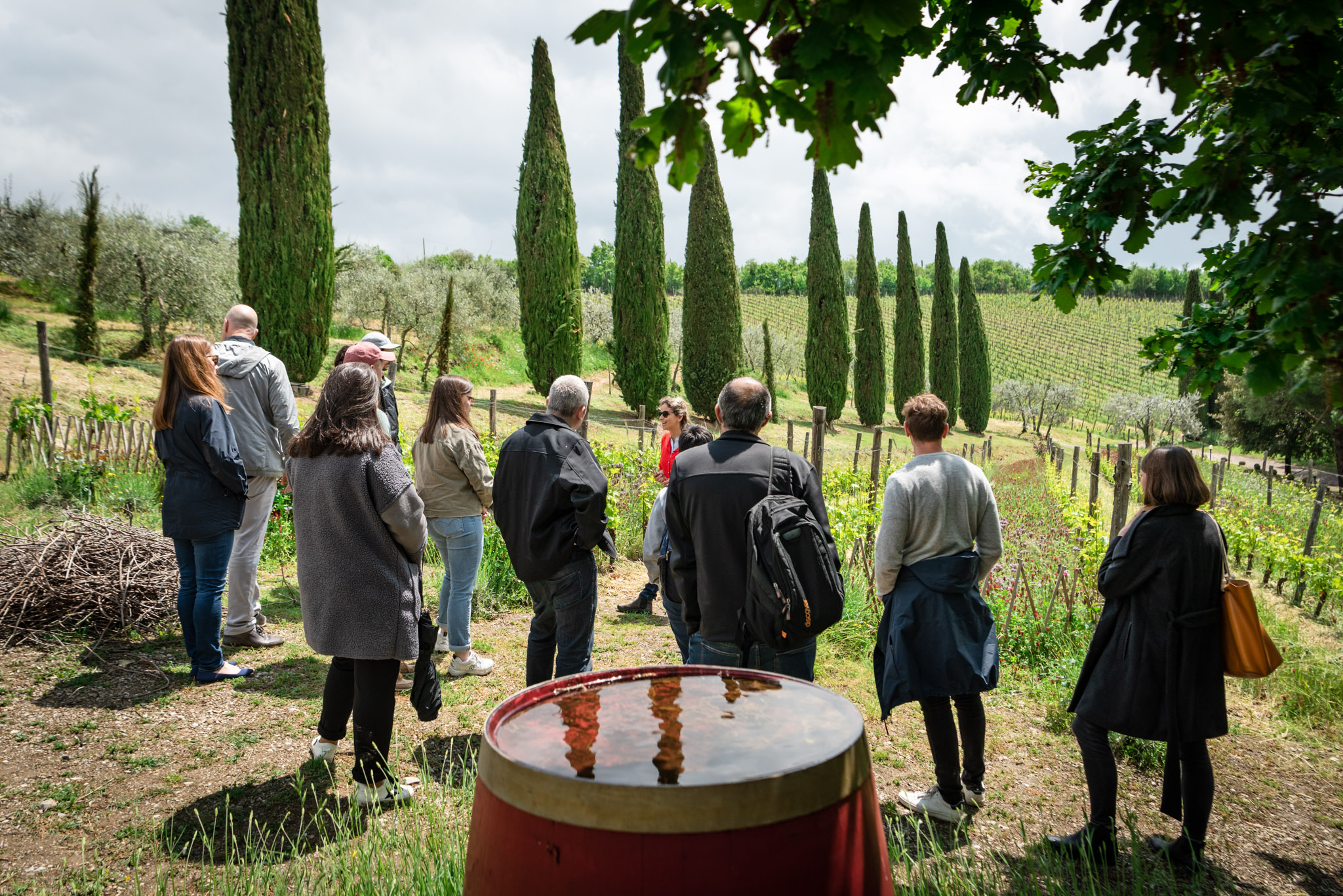
4. Organic is visible in the vineyard, not only in the cellar
One of the most common misunderstandings is focusing only on the cellar.
But organic wine begins in the vineyard, not indoors.
A careful visit should allow you to observe:
-
soil vitality
-
the presence of biodiversity
-
how grass and space are managed
-
the relationship between vineyard and landscape
Truly organic wineries do not hide their vineyards.
They consider them an essential part of the story.
5. Coherence between agriculture and experience
Another important sign is coherence between what is declared and what is lived.
An authentic organic winery:
-
does not rush the experience
-
does not reduce visits to demonstrations
-
does not turn wine into spectacle
Organic farming implies a certain rhythm, even in hospitality.
A rhythm that favors listening, explanation, and relationship.
This is often what separates a deep experience from a purely commercial one.
6. Territory and agricultural memory
Organic farming is never abstract.
It is always rooted in a specific place.
A truly organic winery understands:
-
the agricultural history of its land
-
traditional practices
-
local grape varieties and their behavior
In Tuscany, this means respecting a long memory built through slow adaptation and empirical knowledge.
Places like Fattoria di Montemaggio work in this direction — not by reinventing the territory, but by interpreting it with contemporary coherence.
7. Organic wineries do not seek communication shortcuts
Language reveals a great deal.
Authentic organic wineries:
-
do not shout
-
do not promise miracles
-
do not use organic farming as an aggressive sales argument
They often speak less.
And when they do speak, they explain why they make certain choices, not just what they do.
This type of communication is slower, but far more credible over time.
8. Why conscious choice matters
Choosing an organic winery does not mean choosing “the best wine in absolute terms”.
It means choosing an approach.
An approach that accepts:
-
imperfection
-
variability
-
time as an ally
Those who visit a truly organic winery are not looking for a standardized experience.
They are looking for a real encounter with a place and the people who care for it.
And this is precisely what makes the experience memorable.
Conclusion — Organic as an act of trust
Recognizing a truly organic winery requires attention.
It requires listening.
It requires looking beyond labels.
Authentic organic farming does not promise everything.
It promises coherence.
And for those seeking a meaningful wine experience in Tuscany,
that coherence often makes the difference between a generic visit
and an encounter that stays with you.
Leave a Reply