


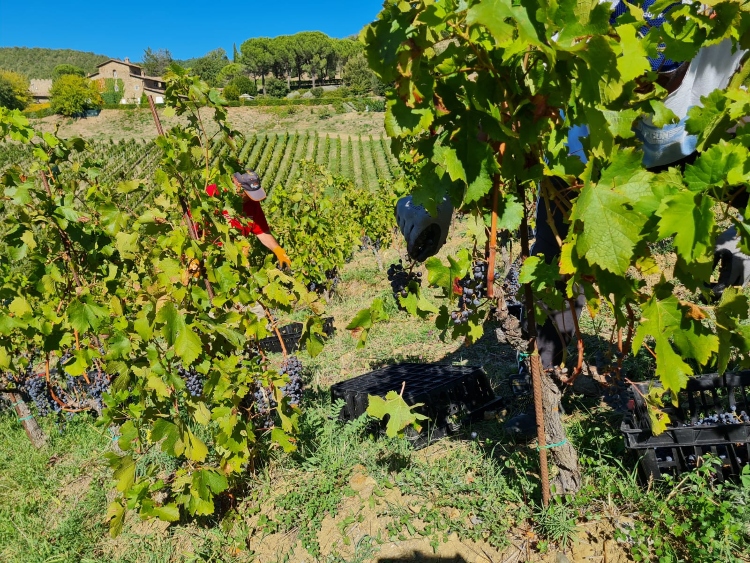
Many travelers arrive in Tuscany with the same goal: to experience a wine tasting in the heart of the countryside.
But once they begin planning their visit, they quickly discover that there are hundreds of wineries offering tastings. The question then becomes more specific.
How do you recognize a truly authentic wine tasting?
In a region as famous as Tuscany, authenticity is not always easy to define. Yet when visitors experience it, they immediately feel the difference.
Authenticity begins with the vineyard
A truly authentic wine tasting does not start in the tasting room. It starts in the vineyard.
Wine is an agricultural product, and the vineyard is where the story begins. Seeing the vines, understanding the soil, and observing the landscape helps visitors understand why the wine tastes the way it does.
In regions like Chianti Classico, the vineyards are often surrounded by forests and olive groves, creating a natural balance that influences the wines.
When visitors walk through the vineyard or look out over the hills, the tasting gains context.
The people behind the wine
Another element that defines an authentic wine tasting is the presence of the people who make the wine.
In many Tuscan wineries, the tasting is guided by someone directly involved in the work of the estate — sometimes a member of the family, sometimes someone who works closely with the vineyards or the cellar.
This changes the atmosphere of the experience.
The tasting becomes a conversation rather than a presentation.
At estates such as Fattoria di Montemaggio, the goal of a tasting is often to create that dialogue between guests and the land through the wines.
Simplicity and clarity
Authentic wine tastings rarely feel complicated.
Rather than overwhelming guests with technical language, they focus on clear explanations.
Visitors are guided through:
-
the characteristics of the grape varieties
-
the influence of the soil and climate
-
the philosophy behind the wines
This approach allows guests to understand the wines naturally, without needing expert knowledge beforehand.
The importance of time
One of the clearest signs of an authentic wine tasting is the pace.
When the experience is rushed, it becomes difficult to truly appreciate the wines.
In more thoughtful tastings, there is time to:
-
observe the wine in the glass
-
discuss impressions
-
compare different wines
-
ask questions freely
This slower rhythm allows visitors to connect with both the wine and the environment.
The atmosphere of the place
Authenticity is also connected to the environment.
In Tuscany, many wineries are located in working agricultural estates rather than purpose-built tourist facilities.
The tasting might take place in a cellar, a farmhouse, or a terrace overlooking the vineyards.
These settings create a sense of place that cannot be replicated elsewhere.
When wine reflects the land
Ultimately, an authentic wine tasting reveals something about the territory itself.
Visitors begin to notice how:
-
the landscape influences the wine
-
the climate shapes the vintage
-
the agricultural choices affect the final expression in the glass
The tasting becomes not only an experience of flavor, but an introduction to the region.
A memory of place
The most authentic wine tastings are remembered long after the visit.
Not because of the number of wines tasted, but because of the feeling of connection.
A connection with the landscape.
With the people who produce the wine.
With the rhythm of life in the Tuscan countryside.
And often, that is what travelers are really looking for when they come to Tuscany.
Leave a Reply